.svg)



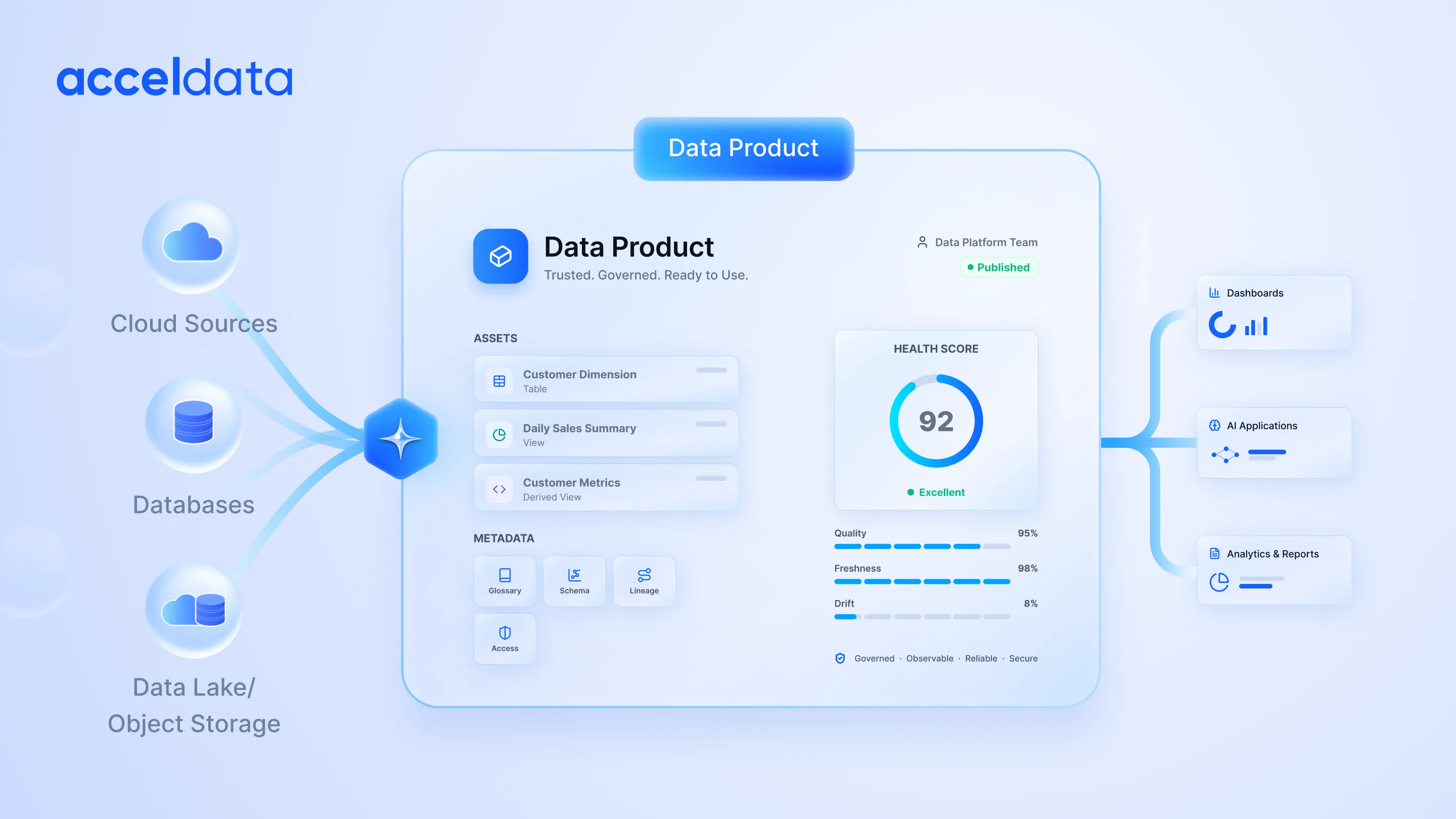
Data products deliver trust at the data layer. But the moment a quality signal is detected and remediated, it stays trapped in the observability platform — never reaching the catalog where business users, data stewards, and AI agents actually decide whether to trust a dataset.
The cost is structural. Stewards manually reconciling quality scores into ServiceNow are always a sprint behind. Business users learn the catalog is stale and stop trusting it. In regulated industries operating under mandates like BCBS 239 or HIPAA, a manual update process creates gaps in the audit trail that regulators expect to be continuous, timestamped, and system-generated. This is not a workflow problem. It is an architectural one — data quality and catalog systems were never designed to talk to each other in real time.
Acceldata ADOC 26.6.0 closes that gap. A native, event-driven integration to ServiceNow's Data Catalog and Governance Core pushes trust badges, quality scores, and full check-run history directly into ServiceNow every time a DQ policy executes on a mapped asset — across the full hybrid estate, not just cloud-native sources. No manual reconciliation. No nightly batch jobs. The catalog stays current because it is fed by the same system that generates the quality signal.
As Loan Leong, Director of Data Analytics and Product Ecosystem at ServiceNow, put it on a recent episode of the Data Forward podcast: "Bringing in that trustworthiness and confidence, making sure the data is high quality and reliable at all times, is the key to scaling AI and delivering the ROI our customers expect."
What the Integration Delivers
Automated quality score and badge push. Every policy execution on a mapped asset pushes the check-run result and a computed trust badge to ServiceNow's catalog via its Data Quality REST API. Trust badges (Good, Moderate, or Poor) are computed against configurable thresholds, so teams calibrate signals to their own governance standards.
Check-run detail visibility. Each push includes the full record: rule name, pass/fail/warning result, execution timestamps, quality score, and a direct link back to the asset's 360-degree view in ADOC. One click from ServiceNow to full observability context.
Source-attributed provenance. Every check run carries source = "acceldata" as a constant identifier. Catalog users and auditors can trace any trust badge back to the ADOC policy that generated it.
Resilient per-asset mapping. ADOC data sources map to ServiceNow's external database connections via immutable system identifier (sys_id), so the integration is unaffected by host renames and connection changes.
Least-privilege security. OAuth 2.0 Client Credentials with short-lived tokens cached in memory, never written to disk. No admin role required on the ServiceNow service user.
No dataplane upgrade required. Control-plane feature. Existing customers get it on upgrade to 26.6.0.
Why This Matters
ServiceNow's Workflow Data Fabric is designed to close the gap between data intelligence and business action. Auto orchestrates enterprise workflows. Pyramid Analytics provides the decision intelligence layer. The Data Catalog provides the semantic context that helps AI agents and human users understand what data means and whether it can be trusted.
Data quality is the missing input. The catalog can describe a dataset's schema, lineage, and business context. It cannot independently measure whether the data is fresh, complete, accurate, and structurally consistent. That requires active observability running against the data itself, across every source, at the scale and complexity of real enterprise environments.
This integration makes Acceldata's observability output a native signal inside ServiceNow's governance ecosystem. The catalog reflects the data's measured health, updated on every policy execution.
For Data Products composed from assets tracked in ServiceNow, this means the product's runtime trust signal and the catalog's governance record stay in sync automatically. AI agents on the ServiceNow platform can consume assets that have been tagged and approved — confident that the quality signal behind that approval is current, not stale.
Two Approaches to Catalog-Level Data Quality
Who This Is For
Getting Started
Setup requires configuration on both sides. On ServiceNow, an administrator registers an OAuth application, creates a least-privileged service user, and deploys a lightweight custom REST endpoint for database connection discovery. On ADOC, the integration is added from the Data Catalogs tab under Register > Add Data Source, with a guided flow for credential validation, threshold configuration, and data source mapping.
ServiceNow integration is the enterprise workflow layer of the Data Product trust chain — runtime scores generated in ADOC, carried into the governance system the business already runs, available to every agent and stakeholder that depends on it.
Full setup documentation is available at docs.acceldata.io/documentation/servicenow.
Hear the full conversation: Acceldata CPO Ramon Chen and ServiceNow's Loan Leong discuss the partnership, Workflow Data Fabric, and the role of data quality in scaling enterprise AI on the Data Forward podcast.
Read Press Release: Acceldata and ServiceNow partnership.