




.svg)



In summary
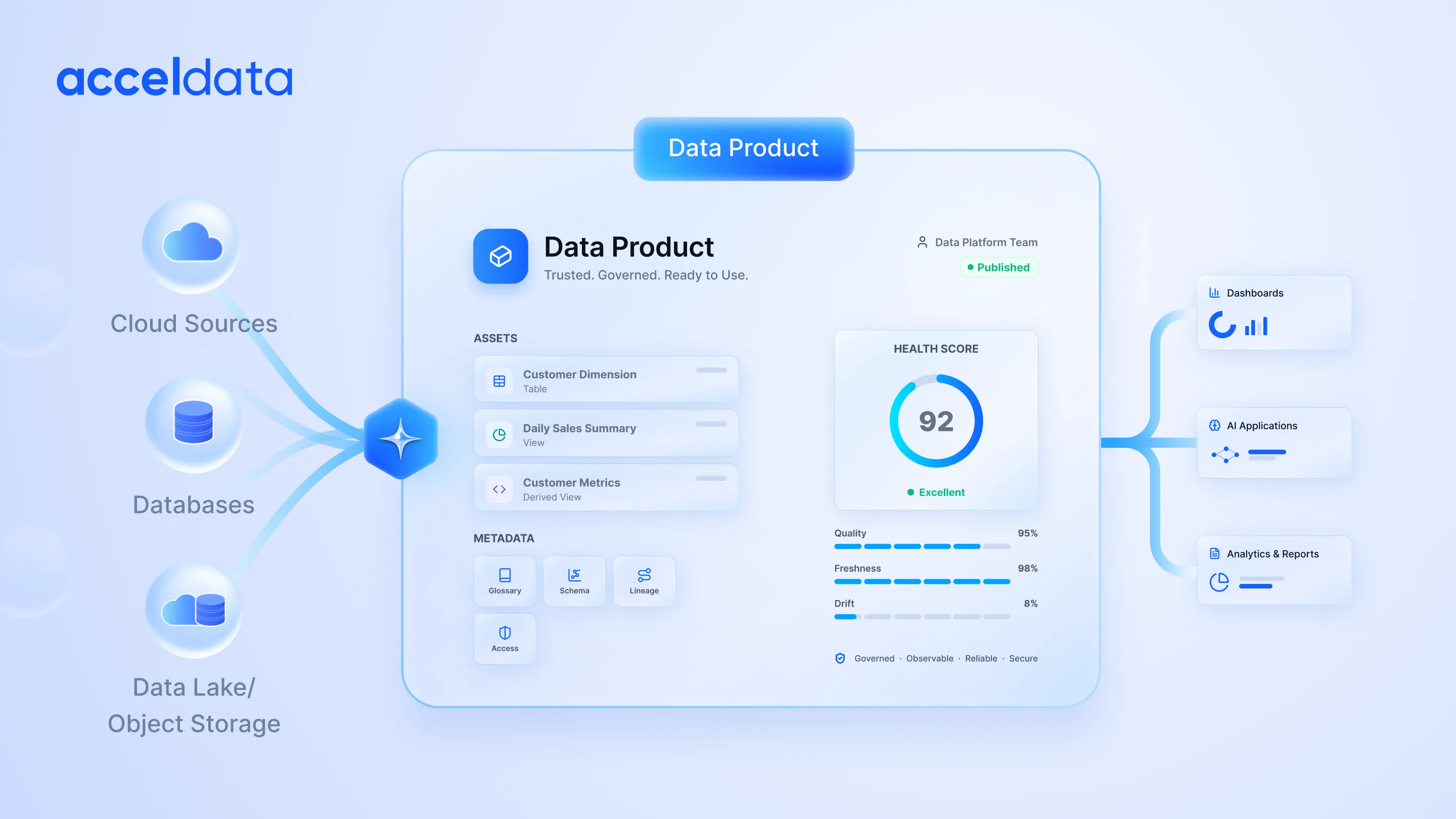
- A data product is now a first-class, governed entity in ADOC, with an owner, a lifecycle, and a runtime reliability score.
- The Health Score is calculated continuously from live Data Quality, Freshness, Schema Drift, and Data Drift signals and not assigned by a steward or inherited from a tag.
- Draft-to-Published lifecycle gates, versioning, audit logs, and Quality SLAs are built in.
- It composes and governs assets across clouds, engines, and on-premises sources — as one scored object, regardless of where the data lives.
Data products have been a convention: a naming pattern, a tag in a catalog, a wiki page pointing at tables. Gartner defines a data product as curated, self-contained data, documented and certified for reuse. In practice, the packaging gets done. The certification stays manual. That gap costs the average organization $12.9 million annually in wasted, untrusted, or rebuilt data work.
That gap was manageable when data consumers were analysts who could ask an engineer if something looked off. It becomes a critical infrastructure risk when the consumer is an autonomous agent. Agents do not pause to verify freshness or check whether a pipeline failed quietly. They act on what they receive — and a data product that cannot prove its own reliability at runtime is not a product an agent can safely depend on.
ADOC 26.5.0 makes Data Products a first-class, governed entity, not a catalog label or a monitoring layer, but an object that carries its own proof of reliability at the point of consumption. The Health Score is not assigned by a steward or inherited from a tag. It is calculated continuously from live Data Quality, Freshness, Schema Drift, and Data Drift signals across every member asset. When something slips, the score reflects it before a consumer has to report it.
And it works across the full estate. The same runtime score applies whether the underlying assets live in cloud, hybrid, or a legacy on-premises system — governed as one object, not per platform. For enterprises operating across a hybrid environment, this is the difference between a data product that claims to be trusted and one that proves it at runtime, everywhere it matters.
The data product challenge, by role
Data Product Owners have no single view of product health and no lifecycle gate to prevent half-ready data from reaching consumers.
Data Engineers field the same trust questions repeatedly: is this fresh, who owns it, what changed. The answers exist but are scattered across tools.
Data Stewards reconstruct audit evidence manually from commit logs, tickets, and memory every time a review comes due.
Business Analysts and Data Scientists discover data by asking an engineer rather than browsing a scored, searchable inventory.
CDOs are asked to stand behind data products in front of regulators but have no single, auditable object to point to.
First, a distinction that matters: a data product is not a report
A Power BI dashboard is not a data product. It is a consumption output.
The data product is the governed collection of tables, views, and metadata underneath those reports, and underneath every other model, application, or agent drawing from the same trusted source. A Customer 360 product might simultaneously feed a marketing dashboard, a churn prediction model, and a compliance report. When any of those consumers asks whether the data is reliable, the answer should live on the product, not on each individual output.
That is true for every consumer — human or agent. An autonomous system drawing from a Customer 360 product needs the same answer the compliance team needs: is this reliable right now?
What's now available
- Health Score Available now
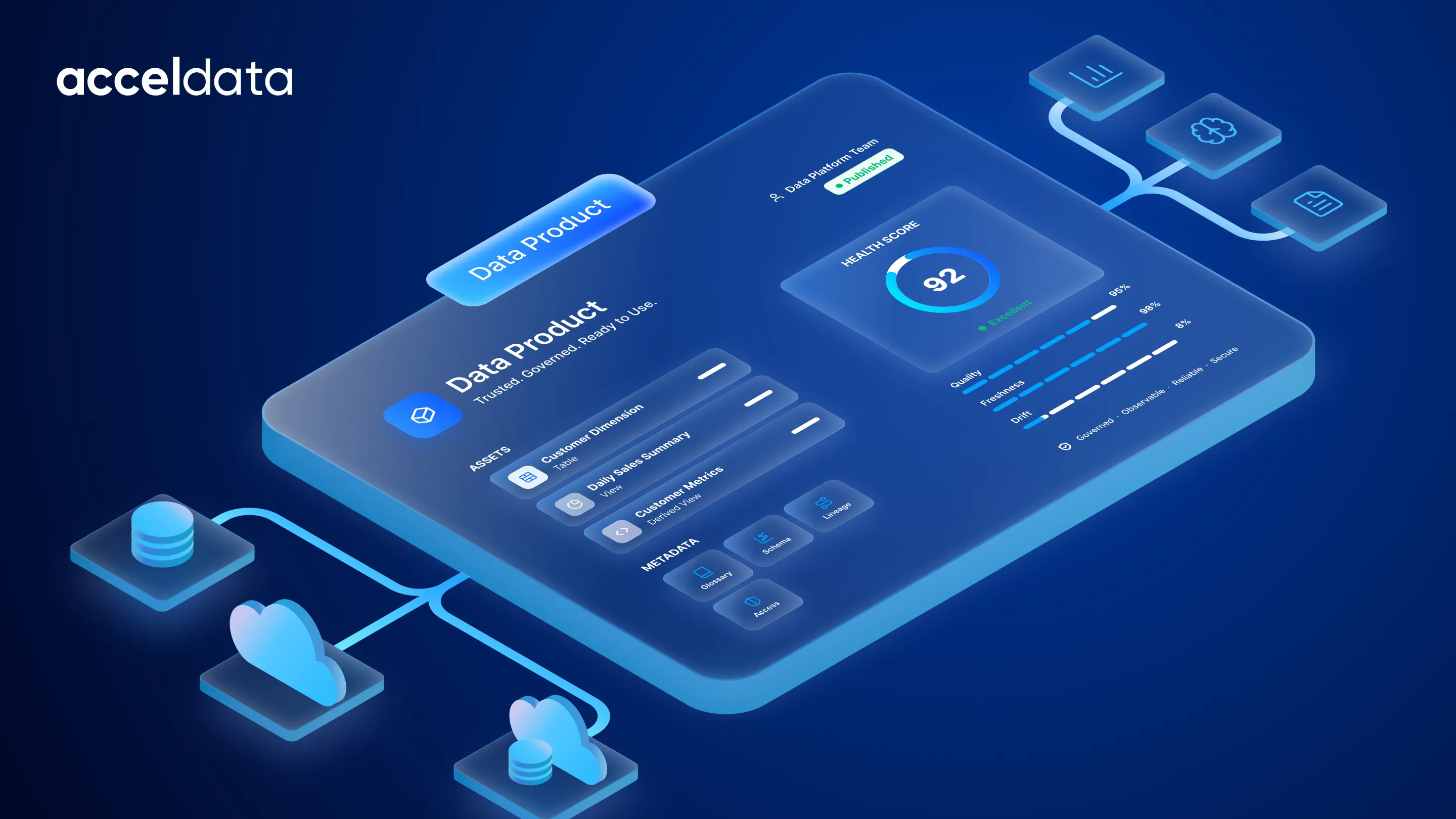
Every Data Product carries a composite score from 0 to 100, calculated as a simple average of the Reliability, Data Quality, Freshness, Schema Drift, and Data Drift scores across all member assets. A Data Product Owner or Data Engineer can evaluate whether a product is safe to build on in one glance, instead of checking each underlying table individually. When something slips, the score makes it visible before a consumer has to report it.
- Ownership and Draft to Published Lifecycle Available now
Nothing half-ready reaches a consumer. The lifecycle gate gives Data Product Owners explicit control over when a product is production-ready, and retiring removes it from discovery without deleting the configuration.
- Entity Level Versioning and Audit Logs Available now
Every edit to a Data Product, including field changes, asset additions, and SLA configuration, is recorded. Data Stewards can answer "who changed what and when" from the product page itself, instead of reconstructing that history from commit logs and tickets before an audit.
- Quality SLAs Available now
Quality SLAs turn a score into a commitment. The score tells you it is healthy today. The SLA tells you it will still be healthy next quarter, and makes gaps in coverage visible before they become gaps in compliance.
- Role Based Sharing Available now
Access is shared by a user group with distinct roles: resource_viewer, resource_editor, resource_owner, and domain_manager. Anyone inheriting or evaluating a Data Product knows exactly who is accountable for it and what level of access they have, without tracing permissions across individual assets.
- Marketplace with Documentation, Reviews, and Ratings Available now
Published products are discoverable by name, owner, or Reliability Score. It helps discover certified products without needing to know which schema or catalog they come from. A markdown documentation editor keeps context attached to the product, and reviews and ratings from consumers provide a second trust signal beyond the score.
- Lineage Available now
End to end lineage helps trace which reports are built from which data products by showing upstream and downstream asset relationships inside the product.
- Policies View Available now
Aggregates all policies running across a product's member assets into a single view, with filters by status, rule set, data source, tag, and policy type. Data team Engineers can spot missing or misconfigured policy coverage at the product level without navigating to each asset individually.
Expected Outcomes
Connect with Us
Read the release notes: ADOC 26.5.0 · ADOC 26.6.0
Read the docs: Data Products in ADOC